Welcome

Oxford

We are both Ole Miss alums. Granted, we graduated a while ago, but once you’ve spent time there it’s difficult to break the tie. It’s also unnecessary to break that tie, so we go back to Oxford whenever we can and revisit our youth. This trip, however, our youth was all we revisited. Everywhere else we went was virgin territory because it seems that we’ve missed a few things over the years.

We started our campus tour with one of our favorite buildings, Ventress Hall, although it wasn’t called that in our day – it was either “the art building” or “the geology building” in those days. Nobody bothered naming the building until 1993, and it’s more than a little surprising that the name Ventress was still available, given that James Alexander Ventress was the legislator responsible for there being a University of Mississippi in the first place! A dark-red, castle-like brick building with gables and a bright red roof, Ventress sits on the Circle, the grassy, park-like expanse at the heart of the original Ole Miss campus. Despite our affinity for Ventress’s charming, fairy tale looks, it had never occurred to either of us to actually go inside, never dawned on us to wonder what that little turret looked like from the other side.

The building began life in 1889 as the library – there’s still an “L” over the front doors. Then it was the law building for a while; after that it was used by the State Geological Survey for over thirty years, and then became the geology building before it became the art building. Now it’s home to the College of Liberal Arts and those folks are lucky indeed. It’s a beautiful place to work, all the more so because of the incredible stained glass window on the landing of the staircase in the elegant foyer – a Tiffany stained glass window right on the Ole Miss campus. Hiding in plain sight. It cost $500 in 1891, a gift from Delta Gamma sorority girls and generous alumni to honor the University Greys, a company of the 11th Mississippi Infantry in the Civil War – almost all of whom were students at the university when war began. Ole Miss had to close for the duration of the war, by the way; all the students were male and only four showed up that first year. The fact that most of the donations that paid for the window probably came from the children, grandchildren, and friends of the men of the 11th makes it even more meaningful. It’s exquisite, a truly magnificent work of art that must be seen to be appreciated…which is why we are posting all these pictures. (Also, we feel some obligation to make up for having lived on campus all those years without knowing it existed. We feel badly about that.)


Getting a picture of the entire window was quite a feat -- it spans most of the stairwell and is over a story high.


The faces were so well detailed -- painted on the glass.

It seems we have several things to feel badly about. We had never quite found the time to drop by the library and see Faulkner’s 1949 Nobel Prize for Literature either. So, we went into the library and inquired of the young (very young) woman at the front desk as to how to find Archives. “They’re on the second floor,” she said with a smile. And then, with what can only be called a “concerned” expression, she asked, “Can you manage the stairs?”
Say what?
She asked if we could manage the stairs! We were speechless. Well, we were speechless until we started up those stairs, and then, believe me, we had plenty to say.
Incredibly, by the time we reached the second floor we had pretty much forgotten that sweet young thing's inadvertent affront. After all, we’ll never know what possessed her to ask such a bizarre question, so there’s no point in worrying about it. There’s obviously something wrong with her. It’s sad.


The medal, approximately 2.5" in diameter, 23 carat gold - really quite pretty!
Anyway, Faulkner’s Nobel Prize, which looks like a rather large gold coin, is right there in the Ole Miss Archives, in a case with first editions of all his books and many honorary medals bestowed on him by various countries. There are portraits of him on the walls, and manuscripts of some of his books tucked away.
From the library we went to check out the Lyceum, which has received much sprucing up since we were students. The oldest building on campus, it is the only building that remains from the original campus. A Greek Revival structure built between 1846-48, this iconic building presides over the Circle and the entrance to campus. It served as a Confederate hospital during the Civil War, and then as a Union hospital when the area changed hands. The building has been added on to over the years and was beautifully renovated in the 1990s. It’s gorgeous, with wall coverings, carpets, window treatments, etc. reminiscent of a fine antebellum home.
Like the columns of many antebellum mansions, the Lyceum’s massive Ionic columns still bear nicks from bullets. Oddly, those bullets didn’t come from Civil War muskets. They date to 1962, when Federal Marshals surrounded the Lyceum to protect James Meredith as he registered as the university’s first black student. A riot ensued, complete with burning cars, tear gas, and the gunfire that left the above mentioned marks. And, while we’re on the subject, there is a beautiful plaza behind the Lyceum, between it and the library, dedicated (in 2006) to this dark period in the university’s history. It’s a beautiful plaza, with a statue of Meredith walking toward a series of arches labeled: courage, perseverance, opportunity, and knowledge. The James Meredith Memorial is also the source of the beautiful quote we borrowed for our home page.
By now we were starving, so we drove into town and visited Bottletree Bakery, just off the square, where we ordered a couple pastries to hold us till dinner. We had a superb raspberry brioche and a Humble Pie, a delicious shortbread/blueberry pastry, and we recommend both. Then, refreshed, we set out for the Made in Mississippi store that apparently no longer exists. So…we amused ourselves with a visit to Neilson’s, the oldest continually operating department store in Mississippi. It’s a great place, a wonderful old store. After that we drove around town admiring the gorgeous new houses/condos and the old homes that have been refurbished so beautifully now that everyone we went to school with is buying a second home in Oxford in preparation for retirement. They really are. Seriously, it’s beginning to look like Parents’ Weekend 1972 around there.
We still had a couple hours to pass before Taylor Grocery opened, so we went antiquing, a great way to unwind before dinner. Eating at Taylor’s has been high on our bucket list for years, but it has proved easier said than done, given that it’s only open Thursday-Sunday nights. We have been to Taylor, a cute, artsy community nine miles out of Oxford, several times, but the timing had never been right to eat at the Grocery. There are no groceries at Taylor Grocery by the way, it’s just a restaurant.


The front door of the Taylor Grocery shows some of the graffiti that decorates almost every flat surface.


Generally, places everyone says you have to try tend to be disappointments, so our primary interest in eating at Taylor Grocery was to be done with it and not have to think about it anymore. As it turns out, we’re still thinking about it. It was wonderful. We had catfish – we love catfish – and we want to go back and have more catfish. Soon.
The Grocery opens at 5:00 p.m., but people start lining up on the porch around 4:30. Despite the fact that the nine-mile drive from Oxford to Taylor is the longest nine miles in the entire world – seriously, it just goes on and on and you’re sure you’ve somehow gotten on the wrong road – we made it there early and sat on the porch to await the opening. As we sat there, we noticed a gallon-sized Jim Beam bottle tied to a rope. The rope ran from the bottle, which hung from the edge of the porch roof, near the stairs, up and across the ceiling and down the wall to the door. When the place opened, and, consequently, the front door opened, we saw the bottle and rope for what they are…a door weight. Seriously, it closes the door behind people.


This bottle works well for a door-closer -- and is a great example of living green in the country.
We went in to find an old country store with writing covering the walls and tablecloths and a profusion of license plates and old senior class pictures hanging on the wall. Historically, Taylor High School has not been the sort of massive institution a child could get lost in. The class of 1965, for instance, had only seventeen students, and only four of them were boys. At least one – maybe two – classes were smaller.
We ordered two-piece catfish filet dinners, which came with hushpuppies and a choice of two sides. We figured that would be plenty, but we were somewhat disappointed to get the smallest catfish filets we have ever seen. Thank goodness we’d ordered that extra side of fried okra! As it turned out, there was plenty of food – their hush puppies are small, but they put five or six on your plate – but next time we might order more catfish just because it was sooooo good. Really. It was delicious, some of the best we have ever had. Perfectly seasoned and not a bit greasy. They advertise that they have the “best catfish in Mississippi” – just like every other place that serves catfish – but they may be right!
We topped off the meal with chocolate cobbler, which the waitress described as a small serving. It came in the same little bowl that school cafeterias used to use, but looks are deceptive – that tiny bowl held a lot of cobbler, which tasted more like a gooey brownie made with really fine chocolate. It was incredible, the best…and it was topped off with a big scoop of vanilla ice cream.
Taylor Grocery surpassed our expectations. The waitress was wonderful, the food delicious. It’s no wonder the wait for a table is long long long if you don’t arrive by 4:30 or so. The fact that it’s a totally unpretentious place is yet another reason to like it. It is what it is. No more. No less. The building itself looks like every country store in the South looked pre-1960s. The floor is wood, not “hardwood.” The doorknob on the women’s bathroom is original – porcelain. And, of course, the “automatic door” is controlled by an old booze bottle. The menu states outright, “Tipping is not a city in Taiwan,” and there is a sign on the front door, scrawled on a piece of a brown paper sack, that states, “We will be closed Sunday nite to watch Eli beat the Patriots.” We wondered why it was still up until we got close enough to see that Eli had autographed it! But, our very favorite thing (after the catfish and the chocolate cobbler) is the restaurant’s motto: “Eat or we both starve.” You have to admire that kind of honesty.


Brown paper sack -- worth a thousand smiles..


Eli "10" Manning autograph makes it even more valuable.

Smithville

We'll be Back

Smithville, Mississippi is about thirty-five miles southeast of Tupelo, almost on the Alabama line. Driving into town on Highway 25, the first hint that something is amiss is the large number of slanted trees – really slanted trees. Some of Smithville’s trees point skyward, but many seem to be growing not toward the sun, but toward the sunrise or sunset. Well, the horizon at any rate. Actually, a good number of them are lying on the ground, another hint that something’s not quite right. Then there is the decided dearth of houses. There’s a house here or there, but for the most part the only roadside sights visible on the drive into Smithville are slanted trees and piles of debris neatly arranged along the roadside. The piles are a few inches to several feet in height and consist of all sorts of things: metal, glass, broken boards, the occasional cooler, ball of wire or bit of furniture. Otherwise, there is little to see for what seems like miles. Actually, it’s just yards – the town of Smithville only covers one and a half square miles – but it’s hard to measure distance without any sort of markers.
This is the largest pile of debris remaining.
Almost all of Smithville’s markers disappeared last April 27 when an EF5 tornado some three miles high cut a swath right down Main Street. Seventeen people died that day – out of a population of about 850. Twenty businesses were leveled, along with two hundred homes, according to USA Today. That’s a lot of homes.

Tarped downtown building -- one of a few that "survived".

This was some tornado, the strongest to hit the area since sometime in the sixties. It roared through town at 200+ miles an hour, destroying everything in its path – pulling forty-foot trees out of the ground, rootballs and all, sucking other trees toward its vortex with such power that they now defy gravity. And, of course, it did what tornadoes always seem to do: here and there it left one house untouched amidst a neighborhood of flattened houses. There’s always that one pristine house left standing just to spook everybody.
The blue tarp in the distance covers one of the damaged school buildings.
School will be starting in Smithville in a couple weeks, although their school was severely damaged and is nowhere near ready for students. It looks like it was a very nice school, which isn’t surprising since Smithville appears to be rather upscale for a place of its size. The 600 students had to finish the last school year at the Advanced Learning Center in nearby Becker, Mississippi, but this year the county’s moving in 44 portable classrooms and they’re all excited to be back in town.
Smithville FEMA trailers
Smithville is amazingly clean for a town that was destroyed only three months ago. Volunteer workers have flooded the place and it’s obvious the townsfolk have been hard at work. As far as trash goes, the piles by the highway seem to be the very tail end of the cleanup and, all things considered, the area is clean as a whistle. Some foundations for new houses have been poured and building and repair work are going on, but it’s slow going starting from total devastation. Still, it’s impressive what has been accomplished so far and we’re going back in a year or two when, no doubt, we will find a beautiful Smithville.

Fun in August

11-13 -- Senatobia -- Tate County Fair -- Northwest Arena, Highway 4 http://www.tatecountyfair.org

12-14 -- Clarksdale -- Sunflower River Blues and Gospel Festival  http://www.sunflowerfest.org

13 -- Southaven -- 9th Annual Memphis Tri-State Blues Festival  http://www.desotociviccenter.com

Fun in July

1-3 Bay St. Louis - Crab Festival - 228 South Beach Boulevard

7-9 Corinth - Slugburger Festival - Downtown

8-9 Bruce - 20th Annual Sawmill Festival - Downtown 662-983-2222

13-16 Choctaw - 62nd Annual Choctaw Indian Fair - 601-650-7450

15-16 Mize - Mississippi Watermelon Festival - Downtown at City Park

16-17 Pass Christian - Leukemia Cup Regatta - Pass Christian Yacht Club

17-21 Oxford - 38th Annual Faulkner and Yoknapatawpha Conference

22-29 Philadelphia - Neshoba County Fair - Fairgrounds

23 Hattiesburg - MS ACTeast - 10:00am-2:00pm - Meador Homestead Cabin - Highway 49N 601-268-3236

Fun in June

June 2-5 – Pass Christian – 36th Annual St. Paul’s Seafood Festival – 140 East Beach Boulevard

June 3-5 – Tupelo – Tupelo Elvis Festival – Downtown

June 4-5 – Biloxi – 82nd Annual Biloxi Fairs Do-Do & Blessing of the Fleet – Biloxi Town Green and Biloxi Small Craft Harbor

June 5 – Grenada – “Thunder on Water” Safeboating Fest – Grenada Lake

June 7 – Biloxi – GRAMMY – 7:30 p.m., Beau Rivage Resort and Casino – 5th annual celebration of Mississippi’s musical legacy ($50)

June 10-11 – Hernando – 3rd Annual Kansas City BBQ Cook-off and Shrine Club Fundraiser – 2888 Gwynn Road

June 18 – Bentonia – Bentonia Blues festival – Blue Front Café, 107 E. Railroad Avenue

June 24 – Greenwood – Stars and Stripes in the Park – Whittington Park

June 25-26 – Southaven – Mid-South Swap Meet & Flea Market –The Arena at Southaven – 7360 Highway 51

Red Bay, Jacinto

We had only a few hours free on Friday, so we decided to take a little side trip we had been talking about for some time, despite the fact that it’s not in Mississippi. (Turns out, that’s not always a bad thing!) We went to Red Bay, Alabama to see “the house” or, more accurately, “the yard,” Mecca for concrete and plaster of Paris dealers the world over.

The house, which sits on Highway 23, merely yards from the Mississippi/Alabama border, is a brick ranch style in a nice neighborhood. It’s tidy enough, but the front yard is a virtual savannah of wildlife…and other things. Mercifully, much of it is white. The very idea of such a gathering being every hue of the rainbow doesn’t bear thinking about.

Although we took plenty of pictures, it’s hard to get close enough to get really clear shots with a point and shoot camera, and we’re not quite brazen enough to nose around someone’s yard given all the gun owners in Mississippi and Alabama. It's impossible to get the full impact in a photo, so let us help you. There are planters, carousel horses, jockeys (with horses and without), baskets, dogs, lions, geese, swans, ducks, wagon wheels, and elephants – and there are multiples of all of these, especially the elephants (more on that later). And, when we say multiples, we don’t necessarily mean just two. There’s also a stagecoach, a well, a chimenea, a windmill, a liberty bell, Donald Duck, Mickey Mouse, a large plastic or metal dump truck (?), and, lucky us, they were drying the floor mats from their cars/trucks, so they were draped over the porch railing. It was a nice touch.

Presiding over this menagerie, front and center, are the Statue of Liberty, Mary, and Jesus. Mind you, they are all 4-8 feet tall. You can’t miss them. And, should any of the lesser ornamentals get out of sorts, there’s an eight-foot grizzly guarding the front door to keep order. Those dogs, lions, geese, swans, ducks, horses, and elephants must be terrified! I know it scared us.


Yep, Bama fans.

We couldn’t see the back yard. Okay, we didn’t really want to, but we noted that, on the side of the yard near the driveway, they have constructed a gazebo with lounge chairs and all. It looks like a nice place to relax, although I can’t imagine the owners would want to be in the front yard with so many people driving by – all of whom must have a thousand questions for them. At any rate, it’s there and decorated (almost solely) with elephants. Turns out they’re big Bama fans. And they’re dedicated – they must have at least twenty elephants.

Anyone who does business in/travels through Red Bay seems to know about “the yard” and, incredibly, we hear that things have actually been tidied up and that much has been removed. This seems difficult to believe, but there were open places on the lawn and these are credible folk saying these things, so….

Red Bay, birthplace of Tammy Wynette, seems like a nice enough little town. They have a fine old downtown hotel that’s being fixed up, there are some other cute buildings, some laudable attempts at murals on downtown buildings, etc., but we were not there to tour Alabama, so we scampered back to TMI Sales in Belmont, Mississippi for a little shopping and accidentally stumbled upon Golden, Mississippi. We had tried to find Golden years ago and couldn’t, so we had thought it was another one of those “map dot only” places, but no…it’s real (small but real), and we were happy to find it. Then we set out for another of our “Bucket List” sites. We went to Jacinto Courthouse.

For decades now, Marian and I have been intrigued by the sign on Highway 45 directing folks to Jacinto Courthouse, and we always planned to visit it “someday.” Turns out May 20, 2011 was the day. For the record, it’s pronounced JUH-sin-toe (or, JUH-sinter), despite the fact that the town was named after the battle of San Jacinto.
Jacinto Courthouse
Cupola of the Jacinto Courthouse

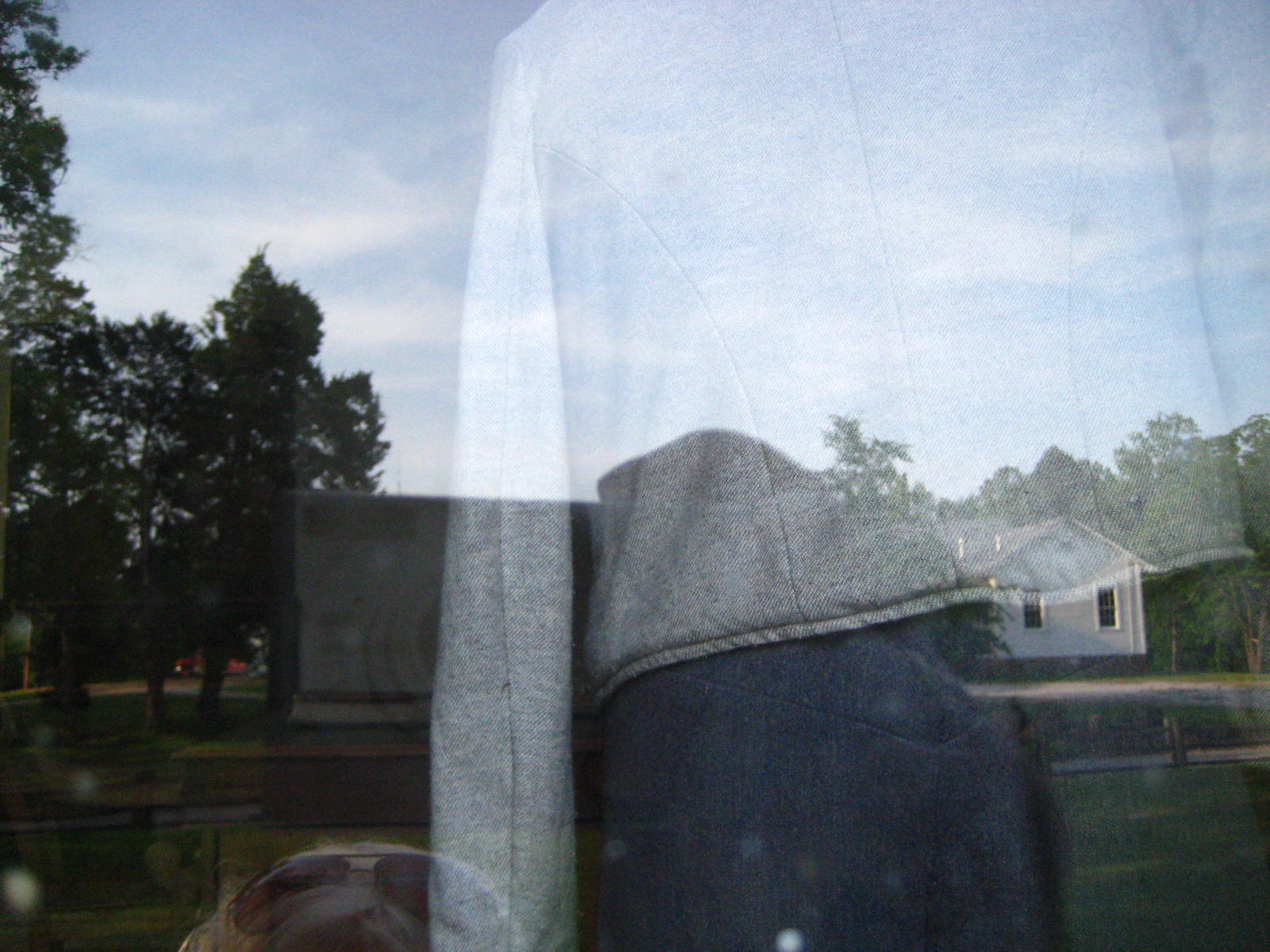
As I sneaked around the exterior of the building taking pictures, I saw the 'ghost'" that I was expecting....see his back? See his coat? Hear me scream? I'm sure it's still hanging in the air around Jacinto.

Yeah, he was a mannequin as you can plainly see, but, from the window behind him he was much scarier...
Jacinto Courthouse is in the middle of nowhere. Well, not really. It’s located in Alcorn County, just off Highway 356 on County Road 367, east of Rienzi and south of Corinth. This is remarkable since it was built in Tishomingo County and has never been moved. (Tishomingo County was huge back then and was later divided up into Tishomingo, Alcorn, and Prentiss Counties.) The courthouse dates from 1854 and is made of hand-quarried foundation stones and handmade bricks. It was a courthouse until 1870, then a school till 1908. From 1908-1960 it was a Methodist church. But the not-so-prescient town fathers had opted out of being on the railroad line along about the turn of the century, so by mid-century Jacinto was almost a ghost town, down to a store or two and a few houses. The Methodist congregation, which had dwindled and virtually disbanded, was offered $600 for the bricks and it seemed a good deal so they agreed. Thankfully, local residents stepped in and set about trying to stave off this impending catastrophe. They succeeded, thanks to a doctor in West Point who wrote a check for $2000 to buy back the building and then set up a foundation to watch over it. Whew. That was close. Really – it’s one of the finest (and one of the few) local examples of Federal style architecture left, given Mississippi’s history of tornadoes and poverty. Although it was closed when we got there, we peeped into windows and supposedly the courtroom is almost intact; other rooms have been furnished to the period – enhanced by the original brick or wood floors. It’s a beautiful structure and well worth a visit.

Hours: May-September: Tuesday-Friday, Sunday – 1-5 pm. Saturday – 10 am - 5 pm April, October, November – Saturday 10-5, Sunday 1-5 It’s free, but they appreciate donations. We can’t give a first-person recommendation for the July 4 celebration at Jacinto, but it’s supposed to be a lot of fun – music, crafts, etc.

When we left Jacinto we were delighted to see signs for Hickory Flat. (Marian --No, this isn't the Hickory Flat that we all know exists on Highway 78 just outside of New Albany. This is another Hickory Flat.) We thought it would make an interesting side trip, but we couldn’t find it. We found other signs directing us to Cairo, however. We had tried (unsuccessfully) to find Cairo just the day before, but this was a different Cairo. Like so many places in Mississippi, there are multiples. We have concluded that surely only one can qualify as a town and the other must be a community. That’s what we think anyway.

Rienzi, however, is real and we found it a little farther down Highway 356. We just drove through, but it appears to be the quintessential small Mississippi town and may be worth another visit. There was even an auction going on! We wanted to stop and check it out, but we ran out of time. Well, really we were hungry so we swung by Booneville and stopped at Fisher’s Family Restaurant. Lucky us – it was catfish buffet night! And it was delicious.

Blue Springs, New Albany

New Albany and Corinth were on our agenda when we left Tupelo on Thursday morning, May 19. We had done a quick run-through of Corinth years ago, with the intention of returning and checking out the area’s rich history when we could devote a full day to it – there’s a lot to see. That was our plan and, by golly, it’s still our plan because we got sidetracked. Getting sidetracked is fun.

New Albany is some twenty-seven miles northwest of Tupelo on Highway 78, but we hopped over to Highway 9 at Blue Springs to check out the new Toyota plant. It seems that Pontotoc, Union, and Lee counties banded together to bring this industry (and a ton of jobs) to Mississippi, where they will be making Priuses. Ginormous hardly begins to describe the place – a massive, cream-colored three-story building with a loading dock that seems to go on forever. There’s nothing around it except empty land (and the brand new “Magnolia Way” exit from Highway 78!), yet security is tight – fences, cameras, gates.

After a quick look around, we decided to see if there really is a Blue Springs or if it is one of those places we find on maps but can’t find in person. Turns out it’s real. It’s a tiny town – population 144 – that dates to 1888, with tidy houses and a pretty town hall. It bills itself as “One of the last true villages in America.” Only later did we learn that some of those 144 people are artists, so we’ll be back to check out Pinion Pottery. As long as we were in the area, we thought we’d scope out the surrounding towns of Ellistown and Fairfield too, but we couldn’t find them.

This happens pretty regularly. Sometimes we mess up and turn the wrong way or don’t drive far enough or something like that, but most of the time there is just nothing to find, they’re communities rather than real towns with stores, fire stations, etc. Invariably there seems to be a Baptist (and it is almost always Baptist) church that bears the community’s name, and when we see a sign for “___ Baptist Church,” we just naturally assume there is a “___.” Although this is almost never the case, we fall for it every time. We see the town on the map and the town’s name on the church sign and set off on a fruitless search for the town itself. What we found this time is that while there is a Fairfield Baptist Church, there is no Fairfield. At least none we could see, so we gave up and headed back to Highway 78.

For many decades, two-lane Highway 78 took you from Tupelo to Memphis and you were lucky if you made it. It was one dangerous highway. Now Highway 78 is a much safer new four-lane, but the original (now not so dangerous) 78 is still there so we went that way for old time’s sake. As is often the case when a highway bypasses a place, all growth had stopped. Seriously, they were the same houses, same businesses, and same kudzu-covered trees we remembered from 1965. Check out the picture of the full-fledged kudzu forest in New Harmony, Mississippi.
Kudzu already reaching for the tops of the trees in May. The extra rain has been excellent for the crop

Speaking of New Harmony, we never actually found it despite the church sign, but the houses we passed as we hunted for “downtown New Harmony” are fairly upscale and neatly tended. There is also a strikingly pretty mauve house that sits near the highway. As if a mauve house wouldn’t be striking enough, this one is very European looking – German or Swiss, maybe. With the kudzu forest looming behind it, it looks like a scene out of some sort of twisted Hansel and Gretel book.

It was right around New Harmony that we saw a truck tethered to a tree. It’s hard to see in the photo, but the truck is tied to the tree as though it’s a horse. Don’t know why. Don’t know if the person who did it knows why. It was so odd that we had to circle around and go back to get a picture but we had to be quick about it. It was in the yard of a fairly uninviting trailer and, after all, these people tied their truck to a tree.
Look at the front ... in the middle of the front bumper... nope, this little truck doesn't look like a mustang.

And now for New Albany. It’s worth remembering here – as in so many other places – that “functional” was the name of the game for our forefathers. While we’re all grateful to them for braving the hardships of settling the new territory that eventually became Mississippi, it would have been nice if they had talked an architect or two into making the trek with them.

New Albany, MS

New Albany, MS

But, busy with the more pressing issue of survival, they overlooked such sissy things and just built what they needed where they needed it. Consequently, like so many other small Mississippi towns, downtown New Albany can’t really be described as visually charming, and certainly not as cute. It has "good bones” though. There are some very nice buildings, including one recently remodeled building that looks very New Orleansish and an Art Deco bank. They’ve also preserved two huge old Coke murals on the sides of buildings. They did a good job of redoing one; the other hasn’t been touched yet.


This Coca Cola add dates circa 1905 per Tommy Sappington. It was covered up when a building was built over it. The building burned several years ago, uncovering this treasure. Sometime around the turn of the century, Coca-Cola had cocaine in it...thus the "Relieves Fatigue" slogan. Mr. Sappington had this sign reconditioned.

Overall, New Albany is an attractive little town with a lot to offer and is well on its way to becoming more so. They’re serious about their refurbishments and seem to have a high regard for historical integrity. When all’s said and done, they’re going to have one of the finer looking towns around. Maybe even on par with Louisville, and that’s saying something.
First National Bank of New Albany
Yep, a railroad track is right in the middle of one of the crossroads in Downtown New Albany. One of the roads parallels the tracks.

We went into Sappington’s, a nice store that has been around forever. They have an old Coke machine sitting near the front of the store that Mr. Sappington bought new in 1956. It’s only about six feet high and maybe two feet across – the smallest (and coolest) machine ever.

This machine has never been reconditioned -- originally purchased for around $20.
It’s in almost mint condition and still has the sign on it saying 10 cents. This started a conversation with “young” Mr. Tommy Sappington (age 56) about when Cokes went from six cents to ten, which morphed into an overview of the historic work going on in New Albany (he worked on restoring the Coke mural), which shops we should check out, and where to eat. He didn’t steer us wrong either, especially with his advice to eat at Tallahatchie Gourmet.
Not a fitting picture - it's the side of the Tallahatchie Gourmet, I took this to help my geriatric memory. The place was quite crowded by 12 -- they have meat and three or specialty salads.


One of my favorite things at the great little shop, Redesigning Women, located across from the Tallahatchie Gourmet. This place had some of the neatest eclectic collections of new and old decorating pieces, jewelry, and furniture.


Another mural, another Coca Cola advertisement -- this one needs a sponsor to recondition it.

We enjoyed New Albany so much that we stayed for hours. Lunch was delicious and the shopping was great. We hadn’t planned on a day of shopping, it just happened, but we enjoyed it and then we walked around New Albany checking out what’s what. It was mid afternoon before we had seen all we wanted to see and since it was too late to go to Corinth, we headed toward Pontotoc on Highway 15 – which for some reason has a plethora of mansions lining it. Real mansions sitting on thirty- to fifty-acre lots…out in the middle of nowhere.

We were driving along admiring the mansions when we spied a sign for the Cairo Baptist Church. Incredibly, we fell for this again and set off to find Cairo. There is no Cairo of course, but it took us a while – and a long drive down a country road – to accept that. We consoled ourselves with a side trip to Ecru. Ashley Furniture has a huge huge huge factory there.

After Ecru, we moseyed over to check out Hurricane, Mississippi. That’s H-U-R-R-I-C-A-N-E, pronounced “Herkin.” We never found it.

The lemons to lemonade award for the trip goes to Sela Baptist Church (yea for us, we didn’t go searching for Sela!). A tree in the church’s front yard died and they cut it down about ten feet off the ground and then carved an eight-foot cross out of the tall stump, similar to the hurricane damaged palms on the Mississippi coast that were carved into all sorts of animals. Brilliant.

We came home via Pontotoc, taking time to snoop around an antique store and eat dinner. Then we unloaded all our loot from the day-long shopping trip, poured a couple glasses of wine, and planned the next day’s trip.